
Abductive reasoning
Logical inference seeking simplest, most likely conclusions from observations.

Abductive reasoning, also called abduction, abductive inference, or retroduction, is a form of logical inference that seeks the simplest and most likely conclusion from a set of observations. It was formulated and advanced by the American philosopher and logician Charles Sanders Peirce beginning in the latter half of the 19th century.
- field
- Logic, Philosophy
- known_for
- Formulating and advancing abductive reasoning
- nationality
- American
- type
- Form of logical inference
Lore & Background
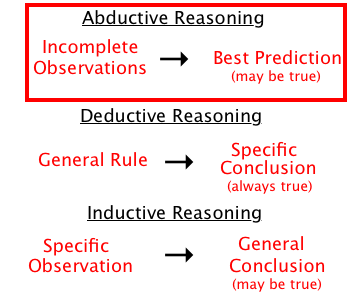
Abductive reasoning yields a plausible conclusion but does not definitively verify it, unlike deductive reasoning which guarantees truth given true premises. Abductive conclusions do not eliminate uncertainty or doubt, expressed in terms such as 'best available' or 'most likely'. While inductive reasoning draws general conclusions applying to many situations, abductive conclusions are confined to the particular observations in question. In the 1990s, as computing power grew, the fields of law, computer science, and artificial intelligence research spurred renewed interest in abduction. Diagnostic expert systems frequently employ abduction. Abductive reasoning allows inferring a precondition A as an explanation of a consequence B, understood as inference to the best explanation, though these terms are not always used equivalently. Abduction is a natural psychological tendency: despite many possible explanations for what we observe, we tend to abduce one or a couple of explanations, disregarding the rest as too confusing. Properly used, abductive reasoning can be a useful source of priors in Bayesian statistics.
Reader's Guide
Abductive reasoning is significant as a distinct form of logical inference, complementing deduction and induction. Unlike deduction, which moves from premise to guaranteed conclusion, or induction, which generalizes from specific cases, abduction reasons backward from observed effects to possible causes. This makes it central to diagnostic reasoning, scientific hypothesis formation, and everyday explanation. The source article notes that in the 1990s, growing computing power spurred renewed interest in abduction across law, computer science, and artificial intelligence, particularly in diagnostic expert systems. Formalizations of abduction include logic-based abduction, where a set of explanations is derived from a logical theory and observations, and set-cover abduction, which inverts a function mapping hypotheses to manifestations. Abduction does not establish certainty but provides a useful orientation and step toward understanding. Its legacy lies in its application to artificial intelligence, where it underpins reasoning systems that must infer explanations from incomplete data, and in Bayesian statistics, where it serves as a source of priors.
Did You Know?
- Abductive reasoning was formulated and advanced by American philosopher and logician Charles Sanders Peirce beginning in the latter half of the 19th century.
- In the 1990s, growing computing power spurred renewed interest in abduction in law, computer science, and artificial intelligence.
- Diagnostic expert systems frequently employ abduction.
- Abductive reasoning can be a useful source of priors in Bayesian statistics.
A Named Form Within Logical Reasoning
Reasoning, broadly understood, is the human capacity to consciously apply logic and draw valid conclusions from information—whether new or already held—with the ultimate aim of seeking truth. Within this expansive domain, scholars recognize several distinct modes of logical reasoning, and abductive reasoning is named alongside deductive and inductive reasoning as one of these recognized subdivisions. Each of these forms engages the intellect in the work of extrapolating from what one already knows toward the generation of something genuinely new. The field of logic, as a discipline, is concerned with how humans can harness formal reasoning to construct arguments that are logically valid and arrive at conclusions that are true. Abductive reasoning, as a member of this family, inherits its place within a framework that has been associated with activities long considered characteristic of human beings: philosophy, religion, science, language, and mathematics. It is, in this sense, part of what is generally regarded as a distinguishing ability possessed by humans, setting their cognitive life apart from other forms of existence.
Roots in the Philosophical Tradition
The intellectual home of abductive reasoning is inseparable from the long philosophical conversation about what reason is and what it does. In classical Greek thought, the original term was logos—a word that could signify speech, explanation, or even a financial account. When this concept was rendered into Latin as ratio, and later into French as raison, the philosophical meaning carried forward into English as reason. Early English-language philosophers such as Francis Bacon, Thomas Hobbes, and John Locke routinely treated these terms as interchangeable, writing in Latin and French while comparing their vocabulary back to Greek. Within this tradition, Aristotle drew a meaningful distinction between logical discursive reasoning and intuitive reasoning, noting that the latter, however valid, tends toward the personal and subjectively opaque. Plato, meanwhile, described reason as the natural monarch of the soul, ruling over spiritedness and the passions. For many classical thinkers, reason was not merely a human trait but something shared with nature itself, linking the mind to the divine order of the cosmos. Abductive reasoning, as a form of logical reasoning, inherits its legitimacy from this deep philosophical soil.
Reasoning as a Bridge Between Ideas
Abductive reasoning operates within a broader cognitive landscape in which thinking moves from one idea to a related idea. Reasoning, in its various forms, is one of the principal mechanisms by which this movement occurs, alongside habit and intuition. It is through reasoning that rational individuals make sense of sensory information arriving from their environments, and it is through reasoning that abstract dichotomies—cause and effect, truth and falsehood, good and evil—are conceptualized and given structure. As a component of executive decision making, reasoning is closely tied to the capacity for self-conscious change: the ability to revise one's goals, beliefs, attitudes, traditions, and institutions. This connection to self-determination and freedom gives reasoning, including its abductive form, a dimension that extends well beyond mere intellectual exercise. In some social and political settings, logical and intuitive modes of reasoning may clash, while in others they are seen as complementary. In mathematics, for instance, intuition is often necessary for the creative processes involved in arriving at a formal proof, arguably the most demanding task in formal reasoning.
Study, Modeling, and the Question of Other Minds
The study of reasoning in all its forms—including abductive reasoning—spans multiple disciplines and raises questions that remain open. Psychologists and cognitive scientists have worked to explain how people reason, investigating which cognitive and neural processes are engaged and how cultural factors shape the inferences individuals draw. The field of automated reasoning takes a different approach, examining whether and how reasoning processes can be modeled computationally. Meanwhile, animal psychology raises the provocative question of whether animals other than humans possess the capacity to reason at all. These inquiries collectively frame abductive reasoning not as an isolated technical procedure but as a phenomenon embedded in biological, cultural, and computational contexts. The etymological lineage of the term itself—tracing from Greek logos through Latin ratio and French raison into English—reminds us that the concept has always been understood as a translation of a philosophical idea rather than a purely technical one. In philosophical contexts, the adjective for reason is typically rational rather than reasonable, and some thinkers, Hobbes among them, used ratiocination as a synonym for the act of reasoning itself.
Gallery
Frequently Asked Questions
Who is Abductive reasoning?
Abductive reasoning is a mode of logical inference first formulated and advanced by the American philosopher Charles Sanders Peirce in the latter half of the 19th century. It is also known as abduction, abductive inference, or retroduction.
What are Abductive reasoning's powers/role?
Its central function is to take a set of observed facts and arrive at the simplest, most probable explanation that accounts for them. Unlike deduction, which guarantees a conclusion from given premises, abduction generates the best available hypothesis from surprising evidence.
How does Abductive reasoning's story end?
Because it is a living method of inference rather than a narrative arc, it has no fixed ending; Peirce's original framework continues to be refined and applied across disciplines. It remains an active tool in logic, philosophy, science, and everyday problem-solving to this day.
Why is Abductive reasoning important?
It fills a critical gap in logical reasoning by providing a principled way to move from 'what we observe' to 'what most likely explains it,' which is essential for scientific discovery and diagnostic thinking. Without it, we would lack a formal method for generating new hypotheses from surprising data.
What field does Abductive reasoning belong to?
It sits at the intersection of logic and philosophy, rooted in Peirce's broader work in semiotics and pragmatism. Its practical applications, however, extend well into science, medicine, law, and artificial intelligence.
More in Philosophical Traditions 1-24
Elsewhere in the Philosophical Traditions universe
Spotted an error? Know more?
This is a living reference — every entry is fact-audited, and reader corrections feed straight into our audit queue. Suggest an edit · See this site's audit record