
Act utilitarianism
Ethical theory judging acts by their specific outcomes.

John Stuart Mill · Public domain
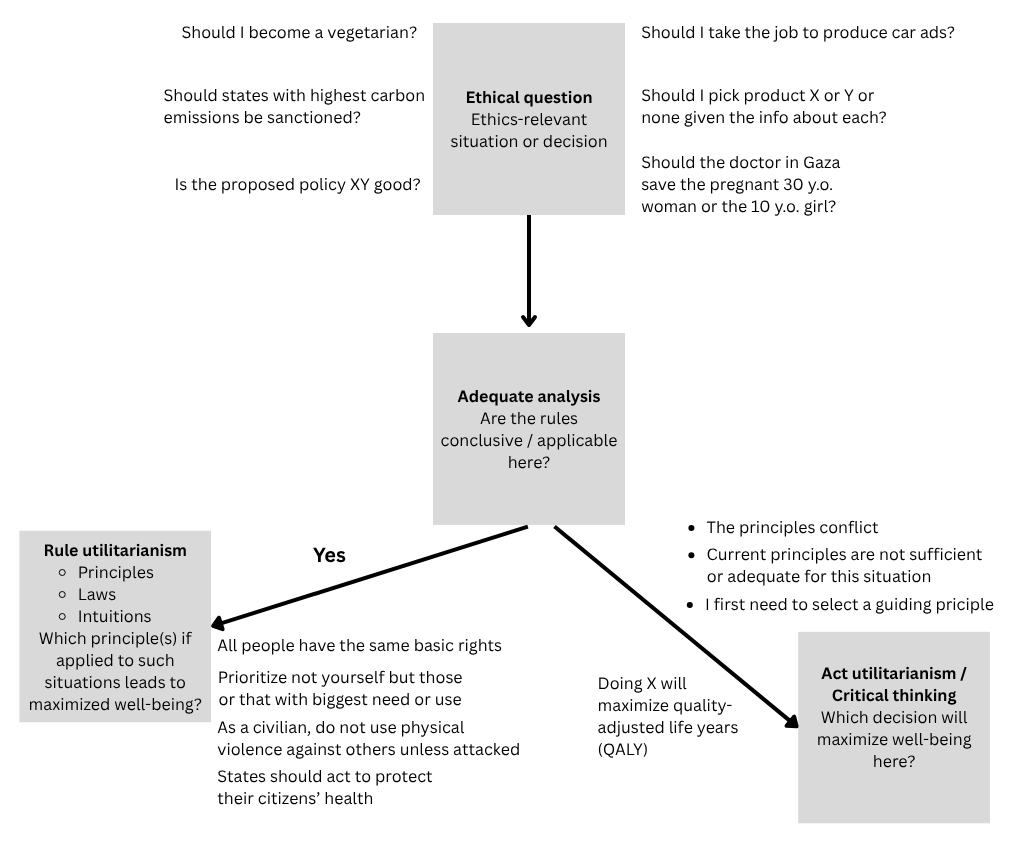
Act utilitarianism is a utilitarian theory of ethics that states that the morally right action is the one that produces the best results in that specific situation. It is based on the principle of utility, described by Jeremy Bentham as 'the greatest happiness for the greatest number,' and is supported by a hedonistic view that defines happiness as pleasure and the absence of pain.
- field
- Ethics
- known_for
- Evaluating each act by its actual consequences to maximize happiness
- key_proponent
- Jeremy Bentham
- related_figures
- John Stuart Mill, Henry Sidgwick
- contrasted_with
- Rule utilitarianism
Lore & Background
Act utilitarianism is a utilitarian theory of ethics that states that the morally right action is the one that produces the best results in that specific situation. Utilitarianism is based on the principle of utility, described by Jeremy Bentham as 'the greatest happiness for the greatest number.' Bentham supported this hedonistic theory with another famous quote of his, that 'Nature has placed mankind under two sovereign masters, pain and pleasure. It is for them alone to point out what we ought to do, as well as determine what we shall do.' Bentham and other classical utilitarians such as John Stuart Mill and Henry Sidgwick define happiness as pleasure and the absence of pain.
Reader's Guide
Act utilitarianism is significant as a direct and straightforward ethical theory that judges each action solely by its actual consequences. Critics sometimes cite such prohibitions on leisure activities as a problem for act utilitarianism. Critics also cite more significant problems, such as the fact that act utilitarianism seems to imply that specific acts of torture or enslavement would be morally permissible if they produced enough happiness. Act utilitarianism is often contrasted with a different theory called rule utilitarianism, which states that the morally right action is the one that is in accordance with a moral rule whose general observance would create the most happiness. Rule utilitarianism is sometimes thought to avoid the problems associated with act utilitarianism. The theory's legacy lies in its clear, consequentialist framework, which continues to be a central point of reference in ethical debates.
Did You Know?
- Act utilitarianism states that the morally right action is the one that produces the best results in that specific situation.
- Jeremy Bentham described the principle of utility as 'the greatest happiness for the greatest number'.
- Critics argue act utilitarianism could permit torture or enslavement if they produced enough happiness.
- Act utilitarianism is often contrasted with rule utilitarianism, which evaluates actions by the consequences of their general practice.
Core Philosophy and Defining Principles
Utilitarianism stands as a family of normative ethical theories united by a single guiding principle: actions should be evaluated by their capacity to produce the greatest overall happiness and well-being for those affected. At its heart lies the concept of utility, which Jeremy Bentham originally described as the power of actions or objects to generate benefits like pleasure and happiness, or to avert harms such as pain and suffering. This framework is a specific branch of consequentialism, the broader view that only the outcomes of an action determine its moral worth. What sets utilitarianism apart from other consequentialist positions like egoism or altruism is its egalitarian commitment: the interests of every person, or even every sentient being, are weighed with equal moral importance. Within the tradition, a fundamental split exists between act utilitarianism, which holds that each individual action should be judged by its likely results, and rule utilitarianism, which argues that agents ought to follow general rules that maximize utility. Further disagreement persists over whether the goal should be maximizing total utility across all affected parties or average utility per individual.
Historical Roots and Pre-Modern Foundations
The intellectual ancestry of utilitarian thought stretches far beyond the Enlightenment. In ancient Greece, the hedonists Aristippus and Epicurus championed happiness as the sole intrinsic good, while Aristotle identified eudaimonia as the highest human end. Even the Christian thinker Augustine observed that every person ultimately desires happiness as their final goal. In ancient China, the philosopher Mozi developed a consequentialist system aimed at maximizing collective benefit and eliminating harm, though his Mohist framework emphasized communitarian goods like political stability and population growth rather than individual pleasure. In medieval India, the eighth-century philosopher Śāntideva articulated a vision in which humanity should work to halt all present and future suffering of every sentient being while simultaneously promoting their pleasure and happiness. In medieval Europe, Thomas Aquinas explored the nature of happiness extensively in his Summa Theologica, and during the Renaissance, Niccolò Machiavelli wove consequentialist reasoning into his political philosophy. These diverse traditions collectively planted the conceptual seeds that would later germinate into a formal ethical system.
Key Figures and the Evolution of the Tradition
The modern utilitarian tradition crystallized in the eighteenth and nineteenth centuries through a succession of influential thinkers. Jeremy Bentham, widely regarded as the founder, articulated the core principle that utility measures an action's capacity to produce pleasure and prevent pain. His philosophical project, often called Benthamism, was substantially reshaped by his intellectual successor John Stuart Mill, who is credited with popularizing the very term utilitarianism. In 1861, Mill claimed credit for being the first to bring the word into common philosophical use, though he acknowledged adopting it from a passing expression in John Galt's 1821 novel Annals of the Parish. Mill apparently did not realize that Bentham himself had employed the term in letters as early as 1781 and 1802. The tradition continued to evolve through the work of Henry Sidgwick, R. M. Hare, and Peter Singer, each contributing distinct refinements. In the eighteenth century, Francis Hutcheson had already articulated the principle that the best action procures the greatest happiness to the greatest numbers, and he even proposed mathematical algorithms for computing the morality of actions, anticipating Bentham's later hedonic calculus. John Gay similarly advanced a systematic theory grounding the pursuit of happiness in theological reasoning about divine will.
Modern Applications and Enduring Debates
Utilitarian reasoning has proven remarkably adaptable, extending well beyond abstract philosophical debate into concrete domains of public policy and moral controversy. The framework has been applied to social welfare economics, questions of justice, the moral urgency of the global poverty crisis, and the ethics surrounding the raising of animals for food. More recently, utilitarian reasoning has been brought to bear on the importance of avoiding existential risks to humanity, a domain where the potential scale of suffering makes the calculus especially stark. The tradition's internal diversity ensures that it remains a living, contested field rather than a single fixed doctrine. Proponents continue to debate whether moral agents should evaluate each action by its probable outcomes or instead commit to following utility-maximizing rules, and whether the ethical aim is to maximize the total sum of well-being or the average level of well-being per person. These ongoing disagreements reflect the tradition's enduring capacity to generate fresh moral insight across an expanding range of practical questions.
Gallery

Frequently Asked Questions
Who is Act utilitarianism?
Act utilitarianism is an ethical framework that judges each individual action solely by whether it produces the best overall outcome in that particular circumstance. It roots its moral calculus in Jeremy Bentham's principle of maximizing pleasure and minimizing pain for the largest number of people.
What are Act utilitarianism's powers/role?
Its core function is to evaluate every single act on a case-by-case basis, weighing the actual consequences to determine which option generates the most happiness. Unlike rule-based approaches, it commits to no fixed moral rules, instead demanding fresh consequentialist analysis for each decision.
How does Act utilitarianism's story end?
Act utilitarianism remains a living and actively debated position in contemporary ethics, continually stress-tested against real-world dilemmas in medicine, public policy, and everyday moral reasoning. Its ongoing tension with rule utilitarianism and deontological theories keeps it at the center of philosophical discourse.
Why is Act utilitarianism important?
It offers the most straightforward consequentialist standard available: do whatever, in this specific moment, yields the greatest net happiness. This directness made it a foundational tool for Bentham, Mill, and Sidgwick in arguing for criminal-justice reform, social welfare, and policy decisions on measurable grounds.
How does Act utilitarianism differ from Rule utilitarianism?
While both share the goal of maximizing overall well-being, act utilitarianism asks 'what should I do right now?' whereas rule utilitarianism asks 'what rule, if universally followed, would produce the best outcomes?' This distinction means act utilitarianism can justify breaking an established rule in a specific case if doing so clearly increases total happiness.
More in Philosophical Traditions 1-24
Elsewhere in the Philosophical Traditions universe
Spotted an error? Know more?
This is a living reference — every entry is fact-audited, and reader corrections feed straight into our audit queue. Suggest an edit · See this site's audit record